ANTHONY MICHAEL COLLADO / d0re
A question.An entire world.
What does a system know about its own state—and what survives when that state is observed?
The Theory of Reality is the thread through my mathematics, simulations, AI research, and working systems. The 15 October record asks the next question: can a prediction survive its instrument?
A living record of independent work.
Mathematics · physics · intelligence · systems
Scroll into the work. Every answer opens another question.
A state becomes a record
01 / THE FRAMEWORK
The answeris a projection.
A complete state and the record we see are different objects. A model needs both: what exists inside it, and the operation that turns it into an observation.
The Theory of Reality organizes that distinction into state, dynamics, interaction, observer, and checked prediction. Its seven layers are a mathematical framework under continuing revision.
Sₜ₊₁ = F(Sₜ, uₜ)
yₜ = Π(Sₜ)
First define the state. Then ask what the observer keeps.
What the observer keeps
02 / THE GEOMETRY
Change the view.Keep the relation.
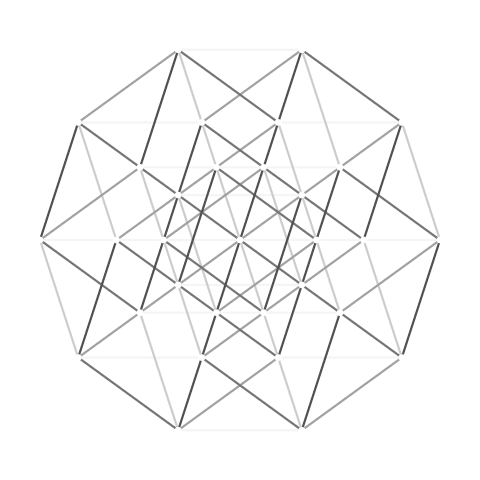
Multiplying two planar shapes produces a four-dimensional Cartesian product. The 3D picture is a deliberate projection of that richer coordinate state.
The shape atlas makes a central question tangible: when the picture changes, which relations remain true? That question returns in atomic envelopes and hidden model states.
A × B ⊂ ℝ⁴ p₃ = π₃ R p₄Explore this instrument
Geometry gives the question an explicit coordinate map.
A richer shape, a chosen view
03 / THE DYNAMICS
A disturbancehas a history.
A boundary moves. A wave travels. Each attached coordinate responds after a finite delay. The rope-and-hair idea becomes an inspectable forward model.
Filament mechanics explore drive, contact, and constraint. Rope tomography reverses the question: what can a delayed observation tell us about the system that produced it?
μ uₜₜ = T uₛₛ v = √(T / μ)Explore this instrument
The forward wave becomes the starting point of an inverse problem.
A response arrives later
04 / THE REFERENCE
Give the wavea body.
Hydrogen gives the programme a precise reference: a wave amplitude, a probability density, and the level surface chosen to display it.
The atom and crystal observers extend into sourced element geometry, basis sites, and interference. Hypotheses that miss the reference stay in the record; those failures refine the model.
ρ = |ψ|² S(q) = Σⱼ exp(2πi q · rⱼ)Explore this instrument
Density, shape, and a displayed surface carry different information.
Amplitude and probability
05 / THE OBSERVER
The world becomesan image.
A field evolves before a detector records it. The spectral work separates physical spectrum, observer response, and display colour.
The Maxwell lab brings that distinction into a discrete electromagnetic volume: source, finite apertures, interference, detector. Water and crystals supply neighboring questions about transport and appearance.
H ← H − Δt curl E E ← E + Δt curl H record = observer(field)Explore this instrument
Trace the signal all the way from a modeled state to a visible record.
From openings to a screen
06 / THE INVERSE QUESTION
Find the relationbefore the search.
RRLS asks whether recognizing the right structure can remove unnecessary branching. Every recognition and rewrite has to preserve meaning and account for its cost.
Chess supplies exact finite reference worlds. Generator and market studies supply holdouts. Together they ask whether a useful relation survives outside the example that revealed it.
recognize → rewrite → verify
fit → freeze → hold out
A shortcut becomes evidence only when its domain and cost are checked.
Recognize the shared relation
07 / THE MODEL RECOVERY
Equal output.Hidden structure.
A replica can match a function without identifying every hidden parameter. DRCT exposes that distinction on complete finite domains.
The GPT-2 work changes the observation contract: internal activation pairs and float32 constraints become part of the recovery method. The next question asks what an exact replica explains—and how a representation carries meaning.
Π(S₁) = Π(S₂)
does the next observation separate them?
Functional equality, parameter recovery, and meaning are separate questions.
Matching the observed response
08 / FROM RESEARCH TO A PRODUCT
An observationdeserves a memory.
A discovery that loses its inputs, revisions, and evidence cannot guide the next session. Keeping the record becomes an engineering problem.
d0fs turns that shared principle into versioned agent memory. D0 Console makes sessions, tasks, and decisions navigable. The connection is practical: carry the evidence forward.
state + change + evidence
→ resumable context
The habit of research becomes a working memory system.
Keep the origin of an answer
09 / THE OPERATING ENVIRONMENT
Make the principlea working world.
The memory layer and Console sit inside the d0 OS development environment. Signed identity, local snapshots, and recovery bring inspectable state into daily use.
The alpha server observes accounts, devices, and health. Remote Desktop adds a measured transport path and checked endpoint identity. Each product has its own deployment and test scope.
identity → state → observation
record → recovery → next state
The theory’s vocabulary reaches engineering through shared principles and components.
A working system carries the result
10 / THE LEARNING RESEARCH
Now let theobserver learn.
GWSN asks how a semantic state could be represented and transformed. Octave asks how communicating temporal observers could learn to predict with memory.
The small recurrent prototype has been trained on a fixed-budget school. Per-bit success and complete-forecast success tell different stories; the benchmark keeps both, along with the failures and compute cost.
8 temporal slots ↔ workspace ↔ memory
observations → prediction → test
An observer architecture enters a school. Its next step depends on the exam.
Observers share a workspace
11 / THE LOOP
A result becomesthe next question.
A model produces a record. A check exposes a gap. New coordinates or a better observer change the next model. The journey continues through that loop.
The current 2.42 programme brings topology, cosmology and measurement discipline into that loop. Read the new investigations, inspect the 57-engine audit, or explore the shared live engine.
S → F → Π → record → test → refineExplore this instrument
State → dynamics → observer → evidence → revision → state.
A result opens the next test
AN INTERACTIVE RESEARCH WORKBENCH
The living
engine.
A model is a question made inspectable. Change its inputs. Follow the calculation. Keep the observation.
Ten browser instruments · individual model scopes
Simulated readings and published references retain their source labels.
- 01Choose a model
Understand its inputs, assumptions and limits.
- 02Change one thing
Compare the response with the baseline.
- 03Keep the observation
Save the parameters, readings and your note.
THE STORY CONTINUES
Make the next
observation count.
The loop acquired topology. The cosmology lost its fitted answer. The instrument acquired an uncertainty model. Follow the work as each test changes the next question.
Enter the current research edition ↗Software regression, conditional mathematics and historical measured-data reanalysis have distinct scopes. Independent calibration and genuinely reserved measurements remain the next physical step.
Where does each model stop?
Start with its next required test.
THE CHRONOLOGY / AUGUST → OCTOBER 2026
Follow the record.
See what changed.
The story follows questions.
The timeline follows the saved work.
Dates identify saved records, manuscript headers, and dated product reports. They are not automatically invention or launch dates.
THE WORK / IDEAS IN RELATION
Every project
has a beginning.
Open a record to see its question,
origin, neighbors, evidence, and scope.
No matching project. Try a different term or choose all work.
Connections name the relationship they support: sourced input, shared method, product component, engineering principle, or proposed transfer.
THE RECORD BEHIND THE STORY
The papers. The code.
The results that changed the question.
Follow the current investigations, inspect the original source catalogue, or return to the browser instruments.
D−0 → D+0 → THE NEXT QUESTION
The journey
is still moving.
Run an experiment. Keep the observation.
See which question it opens next.